Storm Damage Documented Before the Insurance Adjuster Calls
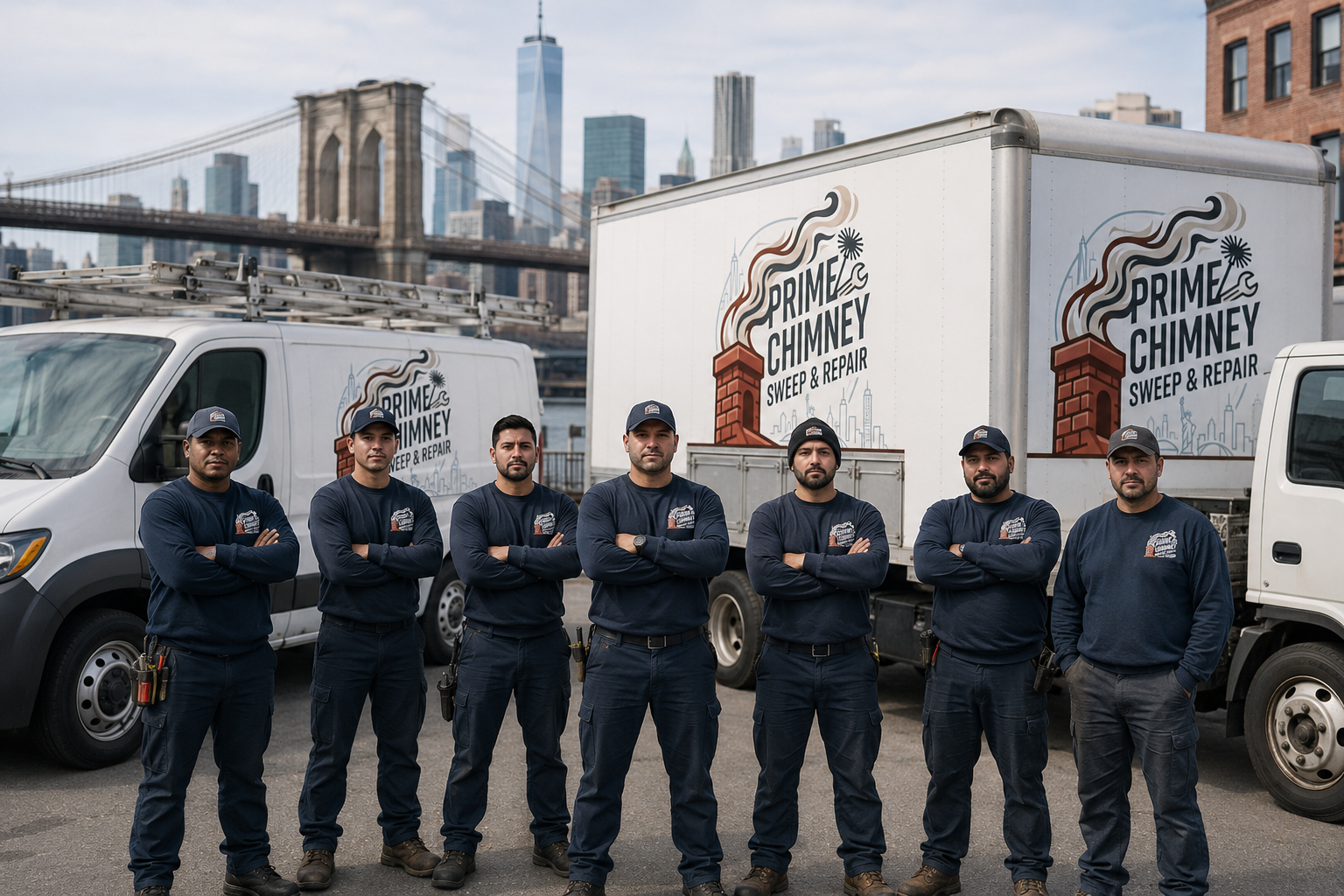
Crew on the roof before the next system arrives. Cap, crown, and flashing assessed in sequence. Timestamped written findings with photos delivered the same day — formatted for insurance carrier and co-op board review.
Damage Assessed, Stabilized, and Documented Before the Next System Arrives
Emergency storm damage chimney repair in NYC means a crew on-site before the next weather system arrives — not days later.
A dislodged chimney cap leaves a flue open to rain, debris, and animals. A cracked crown admits water from every subsequent storm. A separated flashing creates a direct pathway into the roof-chimney junction that gets worse with every rain event until it’s resealed.
When a nor’easter — the cyclonic storm system that strikes the Northeast from the northeast, delivering high sustained winds and wind-driven moisture — passes through New York City, the damage it leaves on rooftop chimneys often isn’t visible from inside the building until water staining appears on a wall or ceiling.
Prime Chimney dispatches a crew, documents the condition with written findings and photos, applies emergency stabilization, and delivers that record before the next system arrives.
Post-Storm Chimney Damage Is Concentrated in Specific Neighborhoods — and We Know Where
Coastal wind exposure during nor’easters produces the highest concentration of post-storm chimney calls in southern Brooklyn.
Prime Chimney dispatches from 919 E. 29th St. in Brooklyn — within direct reach of Red Hook, Sunset Park, and Bay Ridge, the waterfront neighborhoods where coastal wind pressure during nor’easters and tropical remnants hits hardest. These neighborhoods see more dislodged chimney caps and separated flashings per storm than anywhere else in the outer boroughs.
The upwind face of a chimney in a Bay Ridge attached building takes sustained wind-driven moisture loading that an inland chimney on a sheltered block doesn’t. We know which buildings in these corridors have single-flue stacks and which have shared multi-flue configurations. That context matters when triaging post-storm calls across multiple boroughs simultaneously — and with 10 crews available 24/7, we handle them.
One detail property managers often overlook: when one chimney in an attached-building row is damaged, the shared roofline frequently means two buildings are exposed. A separated flashing on a shared party-wall chimney doesn’t let water into one unit alone.
What We Found on the Roof: A Post-Storm Assessment in Brooklyn Heights
A storm damage assessment done right produces a written record — not just a patched cap and a verbal rundown.
The call came in the morning after a nor’easter. A building manager overseeing a four-unit brownstone in Brooklyn Heights could see from the rooftop access hatch that the chimney cap was sitting on the roof surface — not on the flue. That’s a dislodged chimney cap: a cap lifted, rotated, or fully removed from the flue opening by wind force. The flue had been open to rain and debris overnight.
On the roof, the storm damage assessment began — a post-storm inspection of the chimney structure to identify all new damage before the next precipitation event. The cap was gone. Visible immediately. What wasn’t visible from the hatch was the crown condition. Two lateral cracks that hadn’t been there in the spring. Not through-and-through. But with another system forecast for the following week, those cracks were going to admit water.
The flashing on the upwind face had peeled back approximately two inches from the roofline. That’s flashing separation — when the metal seal between the chimney base and the roof surface lifts under wind pressure, opening a direct water pathway into the roof-chimney junction. It begins admitting water immediately. Every subsequent rain event makes it worse until it’s resealed.
The cap was replaced that day. Emergency crown coating went over both cracks. The flashing was reseated with high-temperature sealant. Before leaving the roof, all three conditions were photographed — pre-stabilization and post-stabilization — and the findings were documented in writing.
The building manager had that documentation by the end of the afternoon. When the insurance adjuster called two days later, there was a timestamped written record showing what the damage was, when it was found, and what had been done to stop further water entry. That’s what insurance claim documentation is: a written record that supports the claim filing and gives the property manager a clear account of when corrective action began.
The full crown repair — not just emergency coating — was scheduled as a follow-up scope. Emergency stabilization stops the water. The full repair prevents recurrence.

Documentation Is Standard on Every Emergency Response Visit — Not Optional
Every storm response Prime Chimney performs includes a written condition record delivered the same day.
Every emergency storm damage visit produces condition photos, a written description of what was found and how it was stabilized, and a recommended follow-up scope for any repairs requiring a second visit. That documentation supports insurance claim filings. It gives building owners and co-op managers a timestamped record showing when the damage was discovered and when emergency stabilization was initiated.
In NYC attached buildings — where one chimney event can affect adjacent units sharing the same roofline — that written record has value beyond the single building. If a dispute arises about when water entry began, the documentation answers it.
Storm Damage Standards We Hold Every Visit To
Each post-storm response follows the same assessment and stabilization sequence — no matter the borough or building type.
Full Chimney Perimeter Walk
All four faces assessed, not just the visible side from the access hatch. NYC attached buildings often hide the worst storm damage on the party-wall face.
Crown Condition Check
Hand and visual examination of crack depth and continuity before coating decision. Lateral cracks that look surface-only sometimes track deeper into the crown.
Flashing Inspection
Full perimeter of chimney base, including the party-wall side on attached buildings. Wind-driven separation typically appears on the upwind face first.
Cap Status Documented
Replacement cap selected for flue dimensions — not a universal-fit workaround. The wrong-size cap is the next one to dislodge.
Stabilization Materials On-Board
Every service vehicle carries cap stock, crown coating, and high-temperature flashing sealant for same-visit stabilization.
Condition Photography
Pre- and post-stabilization photos captured before the crew leaves the roof. Required for insurance claim filing and co-op board records.
Written Findings Delivered Same Day
Formatted for property manager and insurance adjuster review. Timestamped record of damage discovered and corrective action initiated.
Follow-Up Scope Identified
Any damage requiring scheduled repair rather than same-visit stabilization is described in writing with a recommended approach.
Storm Just Passed? Get the Documentation Started.
Cap, crown, and flashing assessed in sequence. Timestamped photos and written findings delivered the same day. Insurance-ready record before the adjuster calls. Call (347) 801-0260 — 24/7 from our Brooklyn base.
How Emergency Storm Damage Repair Works
The sequence runs from assessment through stabilization to documentation — in that order, every time.
Storm Damage Assessment
The tech accesses the roof and walks the full chimney perimeter. Each component is checked in sequence: cap, crown, flashing on all four faces, visible upper courses of masonry, and the flue opening. In NYC flat-roof and parapet-wall buildings — where the chimney base sits adjacent to a roof surface where water ponds after rain — the base flashing geometry requires separate evaluation from the cap and crown. A toppled chimney stack, in the event of partial or full collapse of the chimney structure above the roofline, is documented and the surrounding rooftop area is assessed for structural hazard before any other work proceeds.
Emergency Stabilization
Stabilization happens during the same visit when materials permit. A dislodged chimney cap gets a replacement installed immediately. Crown cracks get emergency coating. Separated flashing gets reseated. If damage requires temporary tarping of exposed masonry — or if a toppled section requires structural assessment before work can begin — that determination is made on the roof and documented with a recommended next-step scope.
Post-Service Documentation
Before leaving the roof, all conditions are photographed. The written findings are organized by component: what was found, what was done, what remains for follow-up. The report is delivered to the property contact the same day, formatted for direct submission to an insurance carrier and for co-op board or building management records.
Serving All Five Boroughs After Every Storm
Prime Chimney dispatches to every New York City borough — including the highest-exposure coastal neighborhoods in southern Brooklyn.
Post-storm response covers Manhattan, Brooklyn, Queens, the Bronx, and Staten Island. Call volume after major systems is highest in the neighborhoods where wind exposure is greatest: Red Hook, Bay Ridge, Sunset Park, Howard Beach, Far Rockaway, and the South Shore of Staten Island. Dispatch originates from Brooklyn and reaches every borough on the same call.
Ready for a Post-Storm Assessment? Here's How to Reach Us.
Call (347) 801-0260 — 24/7 — and describe what you found after the storm.
Tell us your borough, your building type, and what you can see from the rooftop hatch or from the street. We’ll confirm crew availability and dispatch from our Brooklyn base at (347) 801-0260.
Documentation is produced on every emergency visit — no need to request it separately.
Frequently Asked Questions
The report is formatted with insurance adjusters in mind. It includes a timestamped record of arrival, condition photographs of each chimney component before and after stabilization, a written description of what was found organized by component (cap, crown, flashing, masonry), the specific materials and methods used for emergency stabilization, and a recommended follow-up scope for any damage requiring a scheduled full repair. Most NYC carriers process this format directly. If your adjuster needs additional supporting detail — proof of replacement cap dimensions, manufacturer specs on the crown coating used, or photographs from a specific angle — we can supply those on request. The same-day delivery is what generally matters most: it establishes when the damage was discovered and when corrective action was initiated.
Post-storm dispatch windows vary by call volume and weather conditions immediately following the system. After a typical nor’easter, our 10-crew operation handles calls across multiple boroughs simultaneously starting the morning the storm passes. Coastal southern Brooklyn neighborhoods — Red Hook, Bay Ridge, Sunset Park — typically see the heaviest volume because the upwind face wind loading there is highest. We prioritize active leaks and structural hazards (a toppled chimney stack, exposed flue with active rain forecast) over closed-flue assessments. When you call, describe what you can see — open flue from the rooftop hatch, ceiling staining, visible cap displacement from the street — and we’ll match dispatch window to the situation.
Schedule the assessment anyway. The storm damage assessment process is exactly the same regardless of whether the damage is attributable to a specific recent storm or accumulated freeze-thaw cycling over multiple seasons. The written findings document what we found — the condition of the cap, crown, flashing, and masonry on the day of the visit. Whether the carrier ultimately attributes the damage to a covered storm event is the adjuster’s call, not ours. We supply the documentation. The earlier the timestamped record is established, the cleaner the claim filing process tends to be.
Emergency stabilization stops further damage from occurring between the visit and a scheduled full repair. A replacement chimney cap installed the same day is a fully functional cap — that one isn’t temporary. But crown coating applied as emergency stabilization over storm-cracked masonry is a different proposition: it holds through subsequent rain events for weeks to months, but the underlying crown still has cracks. The follow-up scope addresses the structural condition. Whether you need a follow-up depends on what we found. The written findings tell you exactly which components were resolved at the emergency visit and which need scheduled repair.
Yes. The written findings come standard on every emergency response — whether you’re the first crew on the roof or you’re documenting conditions for a property owner who wants an independent timestamped record. In NYC attached buildings where one chimney event affects multiple units, multiple condition reports from different dates are common and useful. Each one establishes when that specific assessment was made. Call (347) 801-0260 — we’ll dispatch and produce the documentation regardless of what prior assessments exist.
© Prime Chimney Sweep & Repair · 919 E. 29th St., Brooklyn, NY 11210 · (347) 801-0260 · Licensed & insured · Serving all 5 NYC boroughs 24/7.