
Repair Matched to the Source — Not Patched Over the Symptom
Flashing reseats, crown repair, mortar joint fills, and waterproof coating — each repair matched to the confirmed entry point. Same-visit stabilization on every leak call.

Chimney Leak Repair in NYC Covers Three Distinct Entry Points — Each Fixed Differently
When the diagnostic is done, the repair path depends entirely on where the water is getting in.
Flashing separation, crown failure, and open mortar joints are the three sources a chimney leak inspection finds most often in New York City buildings. Each one requires a different repair method, different materials, and a different timeline. A repair visit that doesn’t start with a confirmed source wastes time. Every chimney leak repair Prime Chimney performs begins with a known entry point — identified before a single tool touches the chimney.
There’s no single fix for a leaking chimney. There are three, sometimes four, depending on what the inspection found. This page explains what each repair involves, what materials are used, and how to know whether your chimney needs same-visit stabilization or a scheduled full repair.
NYC Row Houses and Flat Roofs Create Leak Conditions Specific to This City
Attached buildings, flat roofs, and shared party walls make chimney leak repair in New York City more involved than in detached suburban construction.
Prime Chimney dispatches from 919 E. 29th St. in Brooklyn — within 30 minutes of most Brooklyn, Queens, and Manhattan addresses where post-storm leak calls come in on short notice.
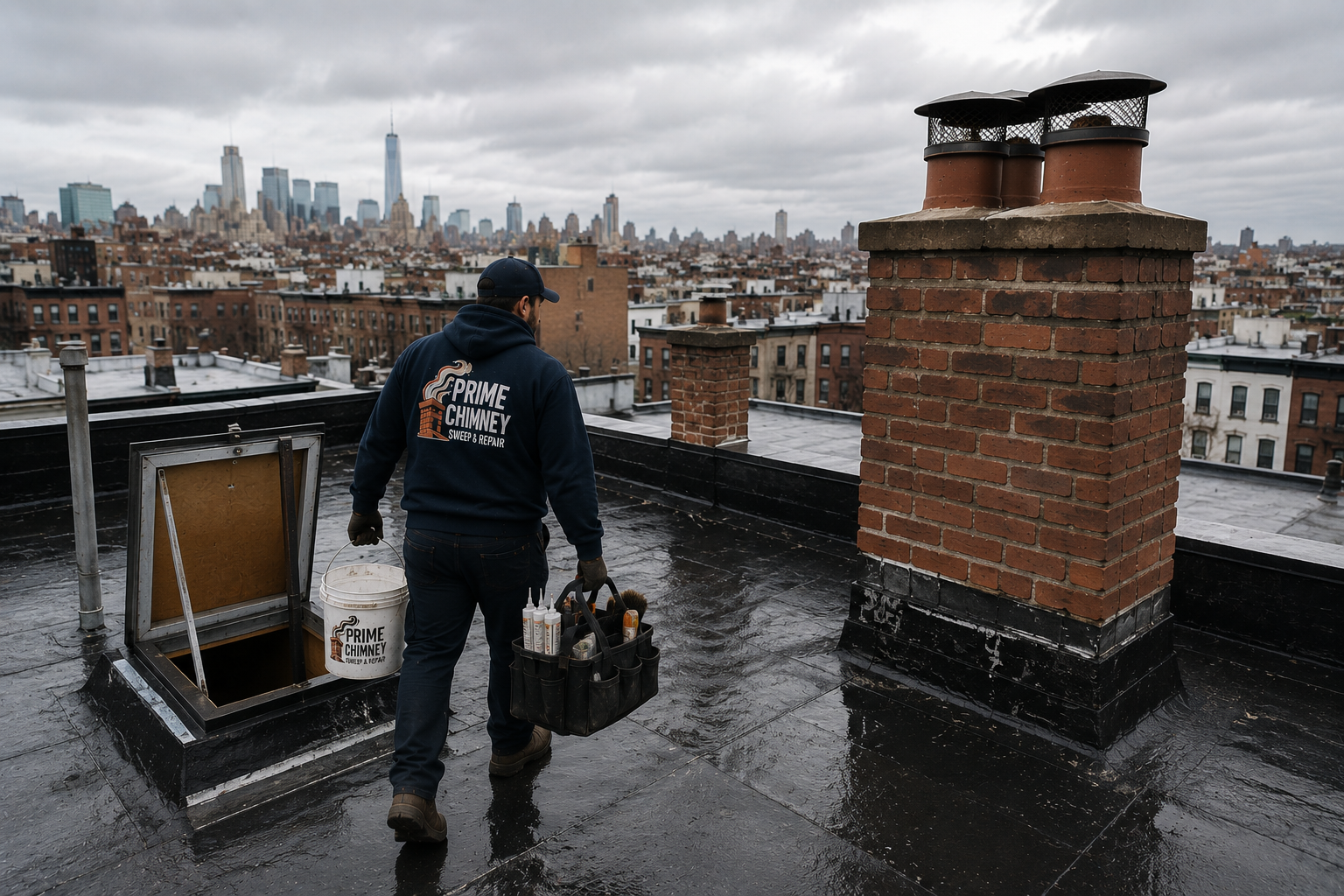
Here’s what most homeowners don’t realize about NYC chimney leaks: the entry point is often on a face of the chimney they can’t see from inside the building. In attached row houses — Bed-Stuy, Crown Heights, Flatbush, Park Slope — the side of the chimney facing the neighboring building carries its own flashing geometry. That side sits at the party wall junction. Water moves through it differently than it does on a pitched suburban roof.
Flat roofs create a second factor. A chimney base surrounded by a low-slope roof surface sits in standing water after every heavy rain. The flashing at that base isn’t shedding water down a slope — it’s keeping water from wicking laterally up into the masonry. When that seal fails, the chimney absorbs water from the base upward.
That’s a different repair than a failed crown at the top. Knowing which one is happening requires assessing the full chimney perimeter, not just the surface visible from the rooftop access hatch.

Here's What Each Chimney Leak Repair Actually Involves
The repair method is determined by the source — and each source requires a different approach, different materials, and a different timeframe.
On this work, the entry point drives everything. A counter-flashing separation where metal meets brick is a different fix than step flashing failure along the slope. Treating one as the other produces a repair that holds for one season.
Here’s how each repair type works:
Flashing Reseat
Re-anchors and reseals the metal junction between chimney base and roof surface. Counter-flashing is removed from its reglet cut, masonry cleaned behind it, and reseated with compatible sealant before re-embedding the edge. Step flashing inspected individually — lifted sections re-nailed and sealed at the overlap. Caulk over separated flashing lasts one winter. A proper reseat lasts years.
Crown Patch vs. Replacement
Hairline cracks in a structurally sound crown sealed with elastomeric patching compound — flexible, waterproof, stays pliable through freeze-thaw cycles. Three coats, not two. A crown fractured all the way through, or separated from the flue liner collar, requires full replacement — removed to sound masonry and rebuilt with the correct drip-edge profile that sheds water away from the brick face.
Mortar Joint Fill
Joints raked back to at least three-quarters of an inch before any new material goes in. New mortar applied over old without raking debonds within one freeze-thaw season. Replacement mortar matched to original lime mix — portland cement on pre-war brick creates a hardness mismatch that fractures the brick face instead of compressing the joint.
Hydraulic Cement Application
Fast-setting compound that stops active water flow — through mortar joints, small crown cracks, or cap-off points during emergency stabilization. Sets in minutes on contact with water. A bridge measure, not a finished repair — used when a chimney is actively leaking and full masonry work can’t be completed the same day.
Waterproof Coating
Applied after structural repairs are complete. Vapor-permeable sealant blocks liquid water entry while letting moisture vapor escape from the masonry. Film-forming sealants — the wrong product — trap residual moisture inside the brick, which freezes and fractures the face from within. Coating goes on last, never over unresolved damage.
Same-Visit Stabilization Means You Don't Wait Through Another Rain Cycle
When a repair can’t be completed in one visit, a temporary stabilization stops water entry the same day.
Every Prime Chimney service vehicle carries emergency patching materials: flashing sealant, hydraulic cement, and temporary crown coating. When a repair visit is booked after diagnostics, a same-visit stabilization can be applied even before the full repair is scheduled.
Here’s why that matters. In NYC attached buildings, an open water entry point doesn’t just affect one unit. Water moves through shared masonry. A separated flashing on a shared roofline lets water into two buildings. If stabilization has to wait a week while materials are ordered, the homeowner sits through another rain event with a known open gap.
Same-visit stabilization is standard on every Prime Chimney leak call. The homeowner doesn’t leave the visit without a sealed entry point.
Some repairs can be completed in a single visit — flashing reseats on accessible rooflines, crown patches on hairline-cracked crowns, and mortar joint fills on a limited number of courses. Full crown replacement and extensive repointing are scheduled repair visits — but they’re scheduled after stabilization has been applied, not before.
Emergency Materials on Every Vehicle
Flashing sealant, hydraulic cement, temporary crown coating. The crew arrives with what’s needed to stabilize, not just to assess.
Entry Point Sealed Before the Crew Leaves
Same-visit stabilization is the default on every leak call — even when full repair requires a scheduled follow-up.
Full Repair Scheduled Around the Stabilization
Crown replacement, extensive repointing, and other multi-day repairs are scheduled after the entry point is sealed — not while it’s still open.
Our Standards for Chimney Leak Repair in New York City
Every repair is matched to the entry point — and every material is selected for NYC’s freeze-thaw environment.
What that means in practice:
Elastomeric Sealant on Crowns
Remains pliable through 30+ annual freeze-thaw cycles. Rigid patches re-crack as the masonry expands and contracts.
Lime Mortar for Pre-War Repointing
Matched to original mix to prevent hardness mismatch. Portland cement on pre-war brick causes the brick face to fracture instead of the joint compressing.
Joints Raked to ¾ Inch Minimum
Bond surface must exist for new mortar to hold through winter. New material over old without raking debonds within a single freeze-thaw season.
Counter-Flashing Fully Reseated
Re-embedded in the masonry reglet cut, not applied over the gap. Surface-applied sealant over a separated flashing lasts one winter; a proper reseat lasts years.
Hydraulic Cement at Active Entry Points
Stops active water flow during emergency stabilization while the full repair is scheduled. Sets in minutes on contact with water — a bridge, not a finished repair.
Vapor-Permeable Waterproof Coating Last
Applied after masonry repairs are complete, never over unresolved damage. Film-forming sealants trap moisture inside the brick and accelerate freeze damage.
Full Chimney Perimeter Assessed
Including the party-wall face on attached buildings — where the entry point on NYC row houses is often located.
Water Actively Coming In Right Now?
Call (347) 801-0260 — 24/7 emergency response with same-visit stabilization materials on every vehicle. Same-day dispatch across most NYC addresses.
How a Chimney Leak Repair Visit Works with Prime Chimney
Diagnostics
Visit begins with confirmation of the entry point identified in the inspection report. Tech accesses the roof and assesses all four chimney faces — including the party-wall side on attached buildings. Crown surface, flashing geometry at the base, and mortar joint condition in the upper courses are each evaluated. Any previously unidentified source is documented and added to the repair scope before work begins.
Implementation
Repairs proceed in sequence: masonry work first (mortar joints, crown), then flashing reseat if needed, then sealant application last. This order matters because applying sealant over incomplete masonry traps unresolved damage inside the treatment. Emergency stabilization — hydraulic cement at active entry points, temporary crown coating, flashing emergency seal — is applied on any visit where the full repair requires a follow-up schedule.
Post-Service Assessment
After repair and sealant application, the full chimney surface is checked for any remaining open joints or gaps. The tech documents the entry points addressed, the materials applied, and any conditions that would benefit from follow-up treatment — including areas where mortar joint deterioration is moderate and likely to progress over the next two to three winters. The homeowner receives that assessment in writing.
Chimney Leak Repairs Across New York City
Prime Chimney repairs chimney leaks across all five boroughs.
Our crews regularly work in Brooklyn neighborhoods including Park Slope, Bed-Stuy, Crown Heights, Flatbush, and Prospect Lefferts Gardens — where attached row houses with flat roofs and party-wall chimneys generate a high volume of persistent leak calls.
We also serve Manhattan, Queens, the Bronx, and Staten Island. If your building is in New York City, we can get there.
Ready to Fix Your Chimney Leak?
Stop the water entry before the next rain cycle.
We’re available 24/7 for emergency chimney leak calls. If water is actively coming in, call (347) 801-0260 now.
Every service vehicle carries hydraulic cement, flashing sealant, and temporary crown coating — so the entry point can be stabilized the same visit, not after another storm passes through. For non-emergency repair scheduling, the same number reaches us any time.
Chimney Leak Repair Questions
It depends on the repair type and the building. Flashing reseats on accessible rooflines, crown patches on hairline-cracked crowns, and mortar joint fills on a limited number of courses can usually be completed the same day on most NYC building types. Full crown replacement and extensive repointing are scheduled repair visits — but they’re scheduled after same-visit stabilization has been applied, not before. Either way, you don’t leave the appointment with an open entry point.
A crown patch uses elastomeric sealant — flexible, waterproof, stays pliable through freeze-thaw cycles — to seal hairline cracks in a structurally sound crown. Three coats. A full replacement is for crowns that have fractured all the way through (where you can see daylight from one side to the other) or separated from the flue liner collar. The old crown is removed down to sound masonry and rebuilt with the correct drip-edge profile — an outward overhang that sheds water away from the brick face. Flat-poured crowns built flush with the chimney fail faster in NYC’s climate.
Bond surface. If new mortar is applied over old without raking the joint back to at least three-quarters of an inch, there’s no surface area for the new material to grip — it debonds within one freeze-thaw season. Raking creates the depth the new mortar needs to actually hold. The replacement mortar also has to match the original mix: portland cement on pre-war brick creates a hardness mismatch that fractures the brick face instead of letting the joint compress. We use lime mortar matched to the original on pre-war work.
No. Hydraulic cement is a fast-setting compound used during emergency stabilization to stop active water flow — through mortar joints, small crown cracks, or cap-off points. It sets in minutes on contact with water. It’s a bridge measure that holds through the next rain cycle while the full repair is scheduled. We use it any visit where the homeowner has active water entry and the full masonry repair can’t be completed the same day. Applied correctly at the right locations, it does its job. But the permanent repair — proper mortar fill, crown rebuild, or flashing reseat — still happens at the scheduled follow-up.
On NYC attached row houses, the side of the chimney facing the neighboring building is often where the entry point actually lives — and it’s the surface homeowners can’t see from inside their own apartment. The party-wall face has its own flashing geometry, especially when adjacent buildings share a roofline at different heights. Building settlement opens gaps at that junction over decades. A repair visit that doesn’t assess all four chimney faces — including the party-wall side — leaves a likely source untouched. Every Prime Chimney leak repair visit checks the full chimney perimeter. Call (347) 801-0260 for a same-week appointment.
© Prime Chimney Sweep & Repair · 919 E. 29th St., Brooklyn, NY 11210 · (347) 801-0260 · Licensed & insured · Serving all 5 NYC boroughs 24/7.