Emergency Response Available · New York City · NYC Metro

Chimney Flashing Repair New YorkIs It Worth It? An Honest Look

Failing chimney flashing is one of the most common sources of water damage in New York homes. Prime Chimney Sweep & Repair gives you a straight answer on when repair makes sense, when replacement is necessary, and what the work actually involves.

24/7

Emergency dispatch

2–4 hrs

Typical repair

NYC &
Metro Region

Service area

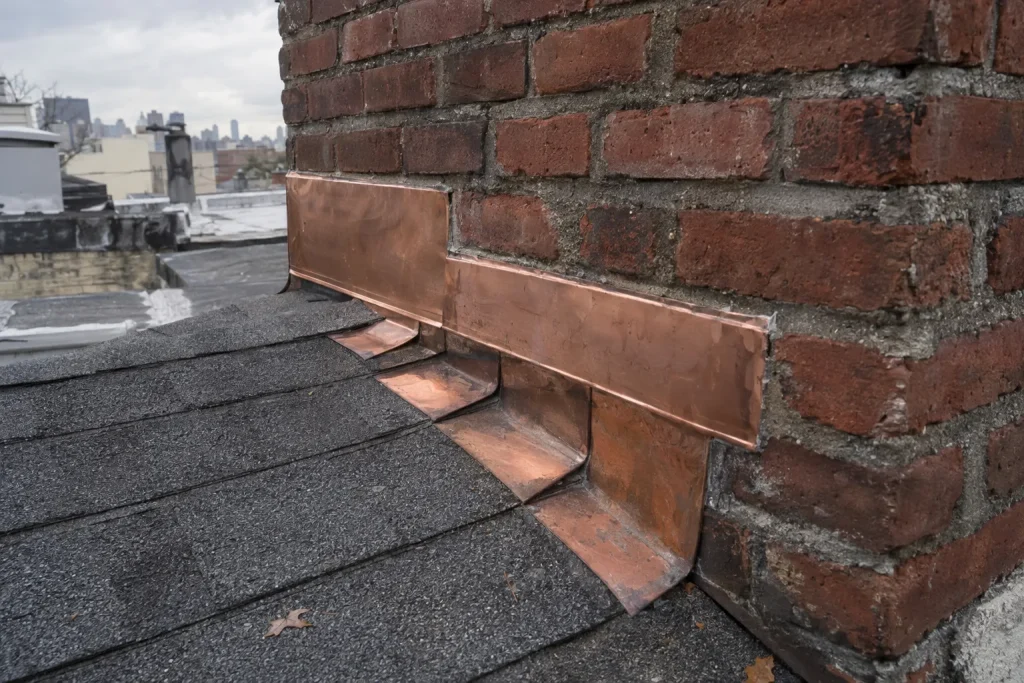
Newly installed copper counter flashing embedded in the mortar joint of a red-brick chimney on a New York rooftop, with step flashing visible beneath where the chimney meets the shingle field, photographed in soft overcast daylight

Active flashing repair, New York City

What We Do in New York

Chimney flashing services for every situation

From a slow drip after a rainstorm to fully separated counter flashing on a Brooklyn brownstone, these are the specific flashing jobs we handle across the NYC metro.

Learn more about fireplace cleaning NYC

  1. Step & Counter Flashing Repair

    Step flashing runs up each course of shingles along the chimney sides. Counter flashing overlaps it from above, embedded in the mortar joint. Both must seal independently. When either fails, water tracks into the wall cavity before showing up inside.

    Chimney leak repair New York
  2. Flashing Replacement

    Original lead or galvanized flashing on older New York homes often reaches the end of its serviceable life after 20 to 30 years. Caulk-only patches on corroded or bent metal are a short-term fix. Full replacement with copper or stainless steel is a durable, long-term solution.

    Chimney leak repair details
  3. Mortar Joint Reseating for Counter Flashing

    Counter flashing is set into a cut or raked mortar joint and sealed with appropriate mortar or sealant. When that mortar deteriorates, the flashing pulls away from the chimney wall even if the metal itself is intact. We reseat and repoint without disturbing adjacent brickwork.

    Leak source diagnosis
  4. Chimney Crown & Cap Repair

    Flashing failure is frequently blamed when water enters from the crown or cap instead. We assess the full top-of-chimney system before attributing a leak to any single component. A cracked crown repaired alongside new flashing prevents a repeat call within the year.

    Crown and cap repair details
  5. NFPA 211 Chimney Inspections

    We perform all three NFPA 211 inspection levels. Level 1 covers accessible components during routine service. Level 2 is required for real estate transactions and includes a video camera scan of the flue. Level 3 involves opening walls or structure when hidden damage is suspected.

    NYC chimney inspection services
  6. Chimney Waterproofing

    After flashing is repaired, applying a breathable masonry waterproofing sealant to the surrounding brickwork reduces water absorption at the chimney-to-roof junction. It does not substitute for sound flashing, but it substantially reduces the volume of water reaching the joint.

    Best applied after flashing is sound

Flashing Repair vs. Full Replacement: The Real Trade-off

Reseating counter flashing and applying appropriate sealant is faster and cheaper, but only makes sense when the metal itself is structurally intact. Corroded, cracked, or improperly installed original flashing will fail again regardless of how well the sealant is applied. We tell you which category your job falls into before quoting either option.

Gas Fireplace & Venting Inspection

Gas inserts and direct-vent units in older New York homes sometimes have flashing problems at the vent termination point rather than the main chimney stack. We inspect both locations. Venting issues and thermocouple or ignition failures are diagnosed as part of our full-system approach.

About Prime Chimney

Straightforward work.
No surprises.

Prime Chimney Sweep & Repair provides chimney flashing repair across New York City and the metro region. We work on the full range, from a straightforward step flashing reseat on a Queens attached home to full counter flashing replacement on a six-story Manhattan building.

Our approach is organized by the actual problem, not by upsell tier. When you call to describe a water stain, we ask where it appears, when it started, and whether it follows rain or temperature change. Those answers narrow the source before we arrive.

New York's housing stock includes pre-war brownstones, mid-century brick multifamilies, and attached rowhouses built before modern flashing standards existed. Many have original lead or galvanized flashing that has been patched repeatedly. Understanding what was done before us is part of diagnosing what needs to happen next. According to the National Fire Protection Association, flashing integrity is a required component of a Level 1 chimney inspection under NFPA 211.
3

NFPA 211 inspection levels offered

NYC

Licensed for NY permit work

For real estate transactions: Level 2 inspections are required by most buyers' attorneys in the NYC metro. Flashing condition is documented in the written report. Scheduling typically takes 1-3 business days.

Why This Work Matters Here

New York chimneys face
specific flashing pressures

New York's freeze-thaw cycle is aggressive. Water that enters a small gap in the flashing joint in autumn expands as it freezes, widening that gap through winter. By spring, what began as a hairline separation is a visible opening. The Chimney Safety Institute of America identifies flashing failure as one of the leading causes of chimney-related water damage in the northeastern United States. Flat or low-slope roof areas common in NYC rowhouses and attached homes increase the contact time between standing water and the flashing joint, compounding the risk.

2-4

Typical job duration in hours for most flashing repairs

1x

Annual chimney inspection minimum per NFPA 211

24

Hour emergency response coverage

L1-3

All NFPA 211 inspection levels performed

New York areas we service regularly for flashing repair

Brooklyn

Brownstones, row houses, pre-war brick stock

Queens

Attached homes, mixed-era chimney construction

The Bronx

Multi-family buildings, older masonry flues

Staten Island

Single-family homes, varied roof pitch and flashing types

Common Questions

What New York homeowners ask about chimney flashing repair

These are real questions from property owners across New York City and the surrounding metro. If your situation is different, call us directly at (347) 801-0260.

Seeing water stains near your fireplace or on the ceiling adjacent to a chimney? Call for a same-day flashing assessment before the damage spreads to framing or plaster.

Call Now

Is chimney flashing repair in New York actually worth the cost?

Yes, in nearly every case. Flashing is the first line of defense between your roof deck and the chimney penetration. When it fails, water tracks into the wall cavity and the roof structure before it ever appears as an interior stain. By the time you see ceiling damage, you may already have wet insulation, rotted sheathing, or compromised plaster. The cost of addressing those secondary issues almost always exceeds the cost of the flashing repair that would have prevented them. The only exception is a chimney in such poor structural condition that repair of any kind is not viable, and that situation is rare.

How do I know if it's the flashing or the roof causing the leak?

The location of the water stain provides the first clue. Leaks that appear directly adjacent to the chimney at the ceiling or on a wall near the fireplace almost always trace to the chimney-to-roof junction. A roof leak unrelated to the chimney tends to appear away from the chimney location. That said, the two can overlap. Common failure points we check systematically include:

  • Step flashing separation where individual pieces have lifted or corroded away from the shingle surface
  • Counter flashing pullout from deteriorated mortar joints at the chimney face
  • Saddle or cricket failure on wide chimneys where water pools against the uphill face
  • Failed caulk-only repairs applied to older flashing that was never properly sealed at install

We inspect the full junction and tell you what is actually failing, rather than assuming it is the flashing or the roof without looking at both.

Do I need a permit for chimney flashing repair in New York City?

Most chimney flashing repair jobs in NYC do not require a permit when they involve like-for-like replacement of flashing material at an existing chimney. However, if the work coincides with structural repairs to the chimney itself, a change in chimney height, or modifications to a landmark building, permit requirements apply. Rules differ by borough and building type. We clarify requirements for your specific address before work starts and handle filings where needed. The NYC Department of Buildings is the governing authority for permit requirements on residential chimney work in the five boroughs.

What does chimney flashing repair typically cost in New York?

Costs vary with chimney size, number of sides requiring flashing, material choice, and roof access difficulty. Reseating counter flashing that has simply pulled from its mortar joint sits at one end of the range. Full replacement of step and counter flashing with copper on a large, multi-sided chimney on a steep-pitch roof sits at the other. See our NYC chimney service cost page for a breakdown by service type. We provide written estimates before any work begins.

Can you just caulk the flashing instead of replacing it?

Caulk is appropriate for sealing the top edge of counter flashing into a mortar joint when the metal itself is sound. It is not appropriate as a primary repair on corroded, bent, or improperly installed flashing. Caulk shrinks and cracks under New York's temperature swings. Applied to deteriorated metal, it typically lasts one to two seasons at best. We use it where it is the correct tool, not as a universal fix. If your flashing has been caulk-patched repeatedly and is still leaking, that is a reliable indicator that the metal needs to be replaced, not patched again.

How long does chimney flashing repair take, and how soon can you get here?

Most flashing repair jobs take 2-4 hours on-site. Full replacement on a larger chimney may run longer, especially if scaffolding or special roof access is required. For non-emergency scheduling, we typically book within a few business days. For active leaks, we offer emergency response and can apply temporary weatherproofing at the first visit to stop water entry while permanent materials are staged. Fall is our busiest window for flashing calls in New York, so scheduling before the first hard freeze in October or November reduces wait time considerably.

Flashing Failing? Act Now

Water gets in fast.
Repair before it spreads.

A failed flashing joint on a New York chimney can let water into the wall cavity through every rain event for months before you notice any interior sign of it. Early repair costs a fraction of what remediation of wet insulation, rotted sheathing, and damaged plaster will cost. Call for a same-day assessment.

Buying or selling in New York?

Level 2 chimney inspections include a documented assessment of flashing condition and are standard for real estate closings in the NYC metro. We produce written reports suitable for attorneys and lenders. Scheduling takes 1-3 business days.

Schedule an inspection

Crown or cap problem too?

Flashing failure and crown deterioration often occur together. Addressing both in a single visit is more cost-effective than scheduling separate repairs. We assess the complete top-of-chimney system on every flashing call.

Emergency chimney leak repair
Prime Chimney Sweep & Repair

Serving New York City and the NYC Metro · © 2026